

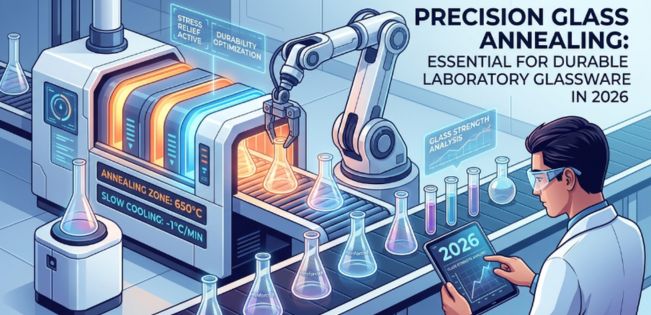
Glass annealing is one of the most important manufacturing processes for laboratory glassware. By carefully controlling the heating and cooling of glass after it is formed, annealing removes internal stresses that could otherwise cause cracking or breakage. In 2026, every leading scientific glassware manufacturer and OEM lab glassware manufacturer relies on precision annealing to produce durable, chemically resistant, and thermally stable laboratory equipment that meets modern scientific standards.
Table of Contents
- What is glass annealing?
- Why annealing matters in laboratory glassware
- How the annealing process works
- Benefits of precision annealing
- Applications across scientific laboratories
- Choosing the right manufacturing partner
- FAQs
What Is Glass Annealing?
Glass annealing is a controlled heat-treatment process performed after laboratory glassware has been shaped.
Freshly formed glass contains internal stresses created during rapid cooling. If these stresses remain, the glass becomes more likely to crack or shatter during normal laboratory use.
During annealing, glass is reheated to a carefully controlled temperature and then cooled gradually. This controlled cooling allows internal stresses to relax, resulting in stronger and more stable glassware.
Why Annealing Is Critical for Laboratory Glassware
Laboratory glassware is regularly exposed to demanding conditions such as:
- High temperatures
- Rapid temperature changes
- Strong acids
- Corrosive chemicals
- Vacuum pressure
- Repeated sterilization
Without proper annealing, even high-quality glass may fail prematurely under these conditions.
Precision annealing ensures that laboratory equipment can withstand daily scientific use while maintaining structural integrity.
How the Annealing Process Works
The annealing process involves several carefully controlled stages.
- Heating: After forming, the glass is placed inside an annealing furnace, where it is heated to a temperature that allows internal stresses to equalize without altering the product’s shape.
- Controlled Soaking: The glass remains at the target temperature long enough for stress throughout the material to become uniform.
- Gradual Cooling: The furnace slowly reduces the temperature according to carefully calculated cooling rates.
This gradual process prevents new internal stresses from forming.
Modern computerized furnaces provide extremely accurate temperature control throughout every stage.
Improved Durability
One of the greatest advantages of precision annealing is increased durability.
Properly annealed laboratory glassware offers:
- Higher mechanical strength
- Greater impact resistance
- Reduced cracking
- Longer service life
- Improved reliability
These qualities are especially important in laboratories where equipment is used repeatedly under demanding conditions.
Better Thermal Shock Resistance
Laboratory procedures often require glassware to move quickly between different temperatures.
For example:
- Heating solutions
- Ice bath cooling
- Autoclave sterilization
- High-temperature chemical reactions
Annealed borosilicate glass withstands these temperature changes far better than poorly processed glass.
This reduces the likelihood of unexpected breakage during experiments.
Supporting Accurate Scientific Research
Reliable laboratory glassware contributes directly to research accuracy.
Cracked or stressed glass may:
- Leak chemicals
- Introduce contaminants
- Affect measurements
- Interrupt experiments
- Create safety hazards
Precision annealing helps maintain dimensional stability and structural integrity throughout the product’s life.
Why Borosilicate Glass Benefits Most
Most premium laboratory equipment is manufactured using borosilicate glass.
Combined with proper annealing, borosilicate glass provides:
- Excellent chemical resistance
- Low thermal expansion
- High heat tolerance
- Superior transparency
- Long-term durability
This combination makes it the preferred material for scientific laboratories worldwide.
The Role of a Scientific Glassware Manufacturer
A trusted scientific glassware manufacturer understands that precision manufacturing extends beyond glass shaping.
Leading manufacturers invest in:
- Advanced annealing furnaces
- Automated temperature monitoring
- Strict quality control
- Dimensional inspection
- Material testing
These processes ensure every product meets demanding laboratory performance standards.
Why OEM Manufacturing Standards Matter
An experienced OEM lab glassware manufacturer produces laboratory equipment according to precise customer specifications while maintaining consistent manufacturing quality.
OEM production often includes:
- Custom dimensions
- Specialized designs
- Accurate calibration
- High-volume manufacturing
- International quality compliance
Precision annealing remains an essential part of every OEM production process.
Industries That Depend on Annealed Glassware
Precision-annealed laboratory glassware is widely used in:
- Pharmaceutical research
- Biotechnology laboratories
- Chemical analysis
- Clinical diagnostics
- Food safety testing
- Environmental monitoring
- Academic research institutions
These industries require durable equipment capable of delivering reliable performance throughout repeated laboratory procedures.
Quality Control After Annealing
The manufacturing process does not end once annealing is complete.
Quality inspections typically verify:
- Structural integrity
- Dimensional accuracy
- Surface finish
- Optical clarity
- Stress-free construction
Only products that satisfy strict inspection standards proceed to packaging and distribution.
Future of Glass Manufacturing
Laboratory glass manufacturing continues to evolve.
Emerging technologies include:
- AI-assisted furnace control
- Automated quality inspection
- Energy-efficient annealing systems
- Smart manufacturing analytics
- Sustainable production techniques
These innovations improve consistency while reducing environmental impact.
Final Thoughts
Precision glass annealing is one of the most important manufacturing processes behind durable laboratory glassware. By removing internal stresses and improving thermal stability, annealing allows laboratory equipment to withstand demanding scientific environments while maintaining strength, accuracy, and safety.
Every reputable scientific glassware manufacturer depends on advanced annealing technology to deliver reliable products for research laboratories worldwide. Likewise, an experienced OEM lab glassware manufacturer combines precision engineering, strict quality control, and controlled annealing processes to produce laboratory glassware that meets the highest scientific standards. As laboratory requirements continue advancing in 2026, precision annealing will remain fundamental to manufacturing glassware that researchers can trust.
FAQs
1. What is glass annealing?
Glass annealing is a controlled heating and cooling process that removes internal stresses from glass, improving strength and durability.
2. Why is annealing important for laboratory glassware?
Annealing improves mechanical strength, thermal shock resistance, chemical durability, and overall reliability during laboratory use.
3. Why choose a scientific glassware manufacturer?
A trusted scientific glassware manufacturer follows advanced manufacturing and quality control processes to produce reliable laboratory glassware that meets demanding scientific requirements.
4. What does an OEM lab glassware manufacturer provide?
An OEM lab glassware manufacturer produces customized laboratory glassware according to client specifications while maintaining consistent quality and precision manufacturing standards.
5. Why is borosilicate glass commonly annealed?
Borosilicate glass offers excellent heat resistance and chemical stability, and proper annealing further enhances its durability and performance in laboratory environments.